Toshiba air conditioner manuals offer crucial specifications, construction details, and troubleshooting guidance for models like RAS-10SK-E.
These resources ensure proper installation, operation, and maintenance.
Importance of the Manual
Understanding your Toshiba air conditioner’s manual is paramount for safe and efficient operation. These documents detail critical installation procedures, preventing potential hazards like electrical shock or fire, especially concerning inverter units.
The manual provides a Toshiba AC error code guide, enabling quick diagnosis of issues. It outlines proper maintenance, including filter cleaning and long-term storage, extending the unit’s lifespan.
Furthermore, access to wiring diagrams, refrigerant cycle diagrams, and parts specifications facilitates informed repairs and replacement, ensuring optimal performance and adherence to FCC compliance standards. Ignoring the manual risks improper function and voiding warranties.
Types of Toshiba Air Conditioner Manuals Available
Toshiba offers several manual types for its air conditioners, catering to different user needs. A primary resource is the comprehensive service manual, like the one for RAS-10SK-E, RAS-10SKX models, detailing intricate components and repair procedures.
Installation manuals guide proper setup, emphasizing ventilation and clearances, crucial for inverter units. Users can also find operation manuals explaining daily usage and troubleshooting common issues.
Increasingly, information is available through online resources at toshiba-lifestyle.com, offering updated specifications and support. These resources range from PDF downloads to interactive guides, ensuring accessibility for all users.

Understanding Your Toshiba Air Conditioner Model
Identifying your specific Toshiba model number is vital for accessing the correct service manual and online resources at toshiba-lifestyle.com for support.
Identifying Your Model Number
Locating your Toshiba air conditioner’s model number is the first step towards accessing relevant documentation. This unique identifier, typically found on the unit’s nameplate, is essential for downloading the correct service manual or accessing support resources. The nameplate is usually situated on the side or back panel of the indoor unit.
Carefully examine the unit, as the label might be small. Knowing your exact model (e.g., RAS-10SK-E) ensures you receive accurate installation procedures, troubleshooting guides, and parts specifications. Without it, finding compatible information becomes significantly more challenging, potentially leading to incorrect repairs or maintenance.
Locating the Service Manual
Finding the correct Toshiba air conditioner service manual is vital for detailed repairs and understanding the unit’s internal workings. While physical copies may be scarce, digital versions are readily available online. A primary resource is often the comprehensive documentation accompanying models like RAS-10SK-E, RAS-10SKX, RAS-10SA-E, and RAS-10SAX.
These manuals contain crucial information, including wiring diagrams, refrigerant cycle details, and microcomputer block diagrams. Searching online repositories or contacting Toshiba directly can also yield results. Ensure the manual matches your specific model number for accurate guidance and safe operation.
Accessing Online Resources (toshiba-lifestyle.com)
Toshiba’s official website, toshiba-lifestyle.com, serves as a central hub for accessing up-to-date information regarding their air conditioning systems. This platform frequently hosts the latest manuals, specifications, and support documentation for various models. Regularly checking this site is recommended, as procedures and details can evolve.
The website also provides details on operating temperatures – ranging from 0°C to 45°C (32°F to 113°F) – and FCC compliance information. Users can find crucial details regarding safe operation and potential interference considerations. Staying informed through toshiba-lifestyle.com ensures optimal performance and adherence to safety standards.
Installation Procedures
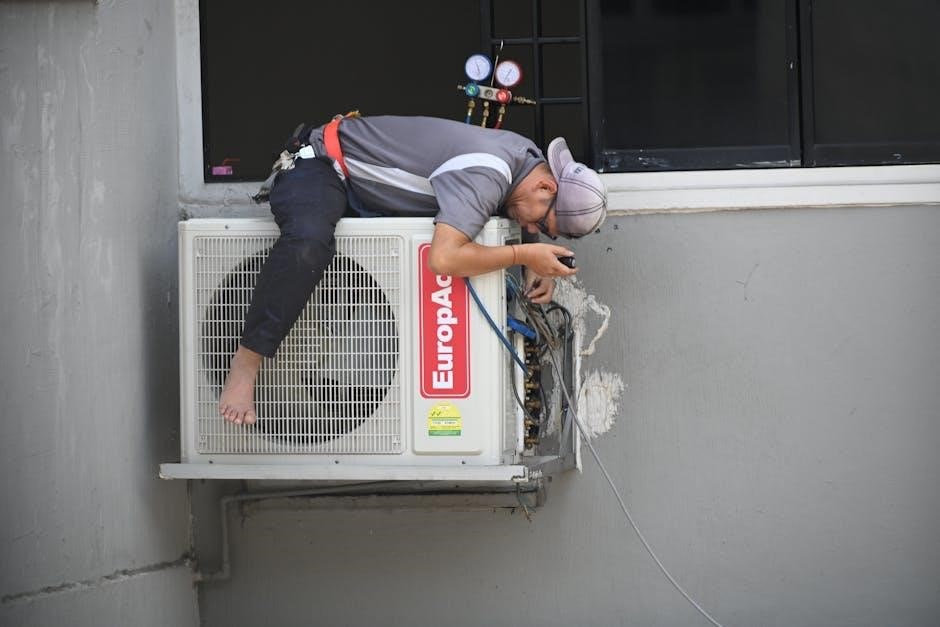
Toshiba recommends vertical inverter mounting on a flat steel wall with adequate ventilation, maintaining at least 10cm clearance between multiple units for optimal performance.
Proper Inverter Installation (Vertical Mounting)
Toshiba inverters require vertical installation on a stable, flat steel wall to ensure safe and efficient operation. Prioritize a well-ventilated location, avoiding obstructions that could impede airflow. When installing multiple inverters in close proximity, maintain a minimum clearance of 10cm between units to prevent overheating and maintain optimal performance.
Secure mounting is paramount; ensure the wall can support the inverter’s weight. Always adhere to local electrical codes and regulations during installation. Improper installation can lead to malfunction, reduced efficiency, or even safety hazards. Refer to the detailed installation manual for specific model requirements and safety precautions.
Ventilation Requirements & Clearances
Toshiba air conditioner installation demands careful attention to ventilation and clearances. Adequate airflow is critical for efficient operation and preventing overheating. Maintain sufficient space around the unit, adhering to the minimum clearances specified in the installation manual. This ensures proper heat dissipation and optimal performance.
Insufficient ventilation can reduce cooling capacity and potentially damage the system. When installing multiple units, ensure adequate spacing between them. Prioritize a location free from obstructions like walls or furniture that could restrict airflow. Always consult the manual for specific clearance requirements related to your model.
Installation Manual – Key Considerations
Before commencing installation, thoroughly review the Toshiba air conditioner installation manual. Pay close attention to refrigerant pipe connections; ensure they are securely connected to prevent leaks. Proper inverter installation is vital – mount it vertically on a flat, stable surface in a well-ventilated area.
The manual details essential safety precautions and operational guidelines. Ignoring these instructions could lead to malfunction, reduced efficiency, or even safety hazards. Always prioritize adherence to the specified procedures for optimal performance and longevity of your Toshiba air conditioning system.
Operation and Usage
Toshiba ACs operate effectively between 0°C ⎻ 45°C (32°F ⎻ 113°F), but maintaining a room temperature below 95°F is recommended for optimal performance.
Operating Temperature Range (0°C ⎻ 45°C / 32°F ─ 113°F)
Toshiba air conditioners are engineered to function within a broad temperature spectrum, specifically ranging from 0°C to 45°C, which translates to 32°F to 113°F. This expansive range ensures reliable cooling or heating performance across diverse climates and seasonal variations. However, it’s crucial to acknowledge that optimal efficiency and longevity are best achieved when the unit operates within recommended parameters.
While capable of functioning at the extremes of this range, prolonged exposure to very high or low temperatures may impact the system’s overall performance and potentially reduce its lifespan. Therefore, understanding and respecting these operational limits is vital for maximizing the benefits of your Toshiba air conditioning system.
Recommended Operating Room Temperature (Below 95°F)
Toshiba recommends maintaining a room temperature below 95°F (35°C) for optimal air conditioner performance and longevity. While the unit can operate at higher temperatures, there’s an increased risk of reduced efficiency and potential operational issues, particularly with extended ductwork. Specifically, units utilizing a 3-meter exhaust duct may struggle to maintain cooling in extreme conditions.
This recommendation isn’t a limitation of the unit’s capability, but rather a precaution against scenarios where lower air intake is obstructed, leading to compromised performance. Prioritizing operation below 95°F ensures consistent and reliable cooling throughout the warmer months.
FCC Compliance & Operating Conditions
Toshiba air conditioners are designed to comply with Part 15 of the Federal Communications Commission (FCC) Rules. This compliance ensures the device won’t cause harmful interference with other electronic equipment. However, operation is contingent upon two key conditions: first, the unit must not generate disruptive interference, and second, it must accept any interference received without malfunction.
Users should be aware that modifications not explicitly approved by Toshiba could void the user’s authority to operate the equipment. Adhering to these operating conditions guarantees responsible and legally compliant usage of the air conditioning system.
Troubleshooting Common Issues
Toshiba AC manuals provide a comprehensive error code guide to diagnose problems, alongside solutions for refrigerant pipe connections and defective inverter operation safety.
Toshiba AC Error Code Guide
Toshiba air conditioner service manuals feature a detailed error code guide, essential for pinpointing malfunctions. This guide lists various error codes displayed on the unit, alongside their corresponding causes. Understanding these codes allows for efficient troubleshooting, potentially avoiding costly service calls.
The manual explains what each code signifies – from issues with the sensors and fan motor to problems with the compressor or refrigerant flow. It’s a critical resource for both technicians and informed users attempting self-diagnosis. Correctly interpreting the error code is the first step towards resolving the issue and restoring optimal performance of your Toshiba AC system.
Refrigerant Pipe Connection Issues
Toshiba air conditioner service manuals emphasize the critical importance of proper refrigerant pipe connections. A key warning highlights the danger of operating the system with an unconnected refrigerant pipe, specifically referencing the service valve. This situation can lead to significant system malfunction and potential hazards.
The manual details correct connection procedures, stressing leak-tight seals to prevent refrigerant loss. Issues can arise from improper tightening, damaged flare nuts, or incorrect pipe sizing. Addressing these connections correctly ensures efficient cooling performance and prevents environmental damage from refrigerant leaks. Always consult the manual before attempting any refrigerant line work.
Defective Inverter Operation – Safety Precautions
Toshiba air conditioner manuals strongly caution against operating the inverter in a defective condition. Such operation presents a serious risk of electrical shock or even fire. The documentation explicitly advises users to immediately request repair services from an authorized Toshiba dealer if any inverter malfunction is suspected.
Proper installation is also paramount; the inverter must be mounted vertically on a flat, steel wall in a well-ventilated area. When installing multiple inverters, a minimum clearance of 10cm between units is required to prevent overheating and ensure safe operation. Ignoring these precautions can compromise safety.
Maintenance and Care
Toshiba manuals emphasize regular cleaning and filter maintenance for optimal performance. Proper care extends the lifespan of your air conditioner and ensures efficient operation.
Regular Cleaning Procedures
Toshiba air conditioner manuals highlight the importance of consistent cleaning for maintaining peak efficiency and air quality. Before any cleaning, always disconnect the power supply to prevent electrical shock. The exterior surfaces should be wiped down with a soft, damp cloth.
For the air filters, remove them carefully and wash with water, allowing them to dry completely before reinstallation. The heat sink fins require gentle cleaning to remove dust and debris, potentially using a vacuum cleaner with a brush attachment. Avoid using harsh chemicals or abrasive cleaners, as these can damage the unit’s components. Regular cleaning contributes to prolonged lifespan and optimal performance.
Filter Maintenance
Toshiba air conditioner manuals emphasize regular filter maintenance as vital for optimal performance. Air filters should be removed carefully and cleaned every two weeks during frequent use, or monthly with less activity. Washing involves gently rinsing with water, ensuring all dust and debris are removed before allowing them to dry completely.
Damaged filters must be replaced; do not attempt to reuse them. A clogged filter restricts airflow, reducing cooling efficiency and potentially causing the unit to work harder. Proper filter maintenance not only improves air quality but also extends the lifespan of your Toshiba air conditioner.
Long-Term Storage Guidelines
Toshiba air conditioner manuals provide guidance for extended periods of inactivity. Before long-term storage, thoroughly clean both the filter and the unit’s exterior. Disconnect the power supply to prevent accidental activation and potential hazards. Ensure the indoor and outdoor units are dry to avoid mold or corrosion during storage.
Cover the outdoor unit with a weatherproof cover, but allow for ventilation. Store any remote controls in a dry location. Periodically check the unit during storage, and consult the manual before resuming operation to ensure all components are functioning correctly.
Technical Specifications
Toshiba manuals detail refrigerant cycles, microcomputer block diagrams, and wiring schematics. These specifications are vital for qualified technicians performing complex repairs and maintenance.
Refrigerant Cycle Diagrams
Toshiba air conditioner service manuals prominently feature detailed refrigerant cycle diagrams. These diagrams visually represent the flow of refrigerant throughout the system – encompassing the compressor, condenser, expansion valve, and evaporator. Understanding these cycles is paramount for diagnosing issues related to cooling performance, refrigerant leaks, or compressor functionality.
The diagrams illustrate the pressure and temperature changes at each stage, aiding technicians in pinpointing the source of malfunctions. They are essential for proper servicing, charging, and ensuring optimal efficiency of the air conditioning unit. Careful study of these diagrams is crucial before attempting any refrigerant-related repairs.
Microcomputer Block Diagrams
Toshiba air conditioner service manuals include comprehensive microcomputer block diagrams. These schematics detail the electronic control system, illustrating the interconnection of various components like sensors, the control board, and the display unit. They are vital for understanding the air conditioner’s operational logic and diagnosing electronic faults.
Technicians utilize these diagrams to trace signal paths, identify faulty components, and comprehend the software-driven functions. Understanding these diagrams is essential for advanced troubleshooting, particularly when dealing with error codes or unusual operational behavior. They provide a roadmap for navigating the complex electronic heart of the unit.
Wiring Diagrams
Toshiba air conditioner service manuals feature detailed wiring diagrams, essential for installation, maintenance, and repair. These diagrams illustrate the complete electrical connections within the unit, showcasing the relationships between the compressor, fan motors, control board, and other components. Technicians rely on these diagrams to safely and accurately troubleshoot electrical issues.
Understanding the wiring configurations is crucial for identifying short circuits, open circuits, and incorrect connections. These diagrams also aid in replacing components and ensuring proper functionality after repairs. Always disconnect power before working with wiring, and consult the manual for specific safety precautions.

Safety Information
Toshiba manuals emphasize electrical shock and fire prevention; defective inverter operation requires professional repair to avoid hazards. Prioritize safety during installation and servicing.
Electrical Shock Hazards
Toshiba air conditioner service manuals strongly caution against operating the unit with a defective inverter, as this poses a significant risk of electrical shock. Always request a qualified Toshiba dealer for any necessary repairs. Improper handling of electrical components can be extremely dangerous.
Ensure the air conditioner is properly grounded and that all electrical connections are secure. Never attempt to disassemble or repair electrical parts without disconnecting the power supply first; Always adhere to local electrical codes and regulations during installation and maintenance to mitigate potential hazards and ensure user safety. Ignoring these warnings could lead to serious injury or even fatality.
Fire Prevention
Toshiba air conditioner manuals emphasize that a defective inverter operation can create a fire hazard. Immediate repair by an authorized Toshiba dealer is crucial if inverter malfunction is suspected. Proper ventilation is paramount; ensure adequate clearances around the unit, especially when installing multiple inverters side-by-side (minimum 10cm).
Avoid obstructing air intake or exhaust vents, as this can cause overheating. Regularly inspect wiring for damage and ensure all connections are tight. Do not use flammable materials near the air conditioner. Following these precautions significantly reduces the risk of fire and ensures safe operation of your Toshiba unit.
General Safety Warnings
Toshiba air conditioner manuals strongly advise against operating the unit if any component shows signs of damage. Electrical shock hazards are present; never attempt self-repair of internal components. Always disconnect power before cleaning or performing maintenance. Ensure the unit operates within the specified temperature range (0°C ⎻ 45°C / 32°F ─ 113°F) and below a recommended room temperature of 95°F for optimal performance.
This device complies with FCC regulations, but operation is contingent on avoiding harmful interference. Adherence to these guidelines ensures safe and reliable operation of your Toshiba air conditioning system.

Parts and Replacement
Toshiba manuals detail parts specifications and provide instructions for replacement. Locate parts through authorized dealers, ensuring compatibility with your specific air conditioner model.
Parts Specifications
Toshiba air conditioner service manuals meticulously list detailed parts specifications crucial for accurate replacements and repairs. These specifications encompass a wide range of components, from the compressor and fan motors to intricate electronic boards and smaller elements like capacitors and relays.
Each part is typically identified by a unique part number, alongside detailed descriptions of its function, dimensions, and material composition. This level of detail ensures technicians and users can source the correct replacement parts, maintaining the air conditioner’s original performance and safety standards.
The manuals often include exploded views illustrating the precise location of each part within the unit, further simplifying the identification process.
Part Replacement Instructions
Toshiba air conditioner service manuals provide step-by-step part replacement instructions, guiding technicians through the process with clarity. These instructions often begin with safety precautions, emphasizing the need to disconnect power before commencing any work.
Detailed diagrams and illustrations accompany each step, showcasing the correct tools and techniques for removing and installing components. The manuals highlight potential challenges and offer solutions, ensuring a smooth and efficient repair. Specific torque specifications for fasteners are frequently included, preventing over-tightening or loosening. Following these instructions precisely is vital for maintaining the unit’s integrity and performance.
Finding Replacement Parts
Toshiba air conditioner service manuals contain comprehensive parts specifications, including part numbers and detailed descriptions, essential for accurate ordering. Locating replacement parts typically involves contacting authorized Toshiba dealers or specialized HVAC parts suppliers.
Online resources, such as the Toshiba Lifestyle website (www.toshiba-lifestyle.com), may offer parts catalogs or links to approved distributors. When ordering, verifying the model number of your air conditioner is crucial to ensure compatibility. Providing the correct part number minimizes errors and ensures you receive the appropriate component for a successful repair.
Advanced Troubleshooting
Service manuals provide construction views and troubleshooting charts for complex repairs, aiding technicians in diagnosing issues within Toshiba AC systems effectively.
Using the Service Manual for Complex Repairs
For intricate repairs on your Toshiba air conditioner, the service manual becomes an indispensable tool. It details construction views, allowing technicians to visualize internal components and their relationships. Furthermore, the manual offers comprehensive troubleshooting charts, systematically guiding users through diagnostic procedures based on observed symptoms and error codes.
These charts pinpoint potential causes and recommended solutions, streamlining the repair process. Understanding wiring diagrams and microcomputer block diagrams is also crucial for addressing electronic malfunctions. The manual empowers skilled individuals to tackle complex issues, ensuring efficient and accurate restoration of the air conditioning system’s functionality.
Understanding Construction Views
The Toshiba air conditioner service manual provides detailed construction views, essential for disassembly and repair. These diagrams illustrate the arrangement of internal components, including the compressor, evaporator, condenser, and associated circuitry. Technicians can utilize these views to understand how parts connect and interact within the system.
Careful study of these illustrations aids in identifying specific components during troubleshooting and facilitates accurate reassembly after repairs. Recognizing the physical layout is crucial for safely accessing and replacing parts, minimizing the risk of damage or incorrect installation. These views are foundational for effective service work.
Interpreting Troubleshooting Charts
Toshiba AC troubleshooting charts, found within the service manual, are vital for diagnosing issues. These charts correlate error codes displayed on the unit with potential causes and recommended solutions. Technicians systematically analyze symptoms, referencing the chart to pinpoint the source of the problem – be it refrigerant leaks, inverter malfunctions, or electrical faults.
Effective use requires understanding the chart’s structure and interpreting the listed conditions. Following the suggested steps, often involving component testing, leads to accurate repairs. These charts streamline the diagnostic process, reducing downtime and ensuring efficient service, ultimately restoring optimal air conditioner performance.